

The History of Our Embossed Products: 200 Years of French Craftsmanship
At Volgara, every piece of jewelry begins with a piece of metal that is two centuries old
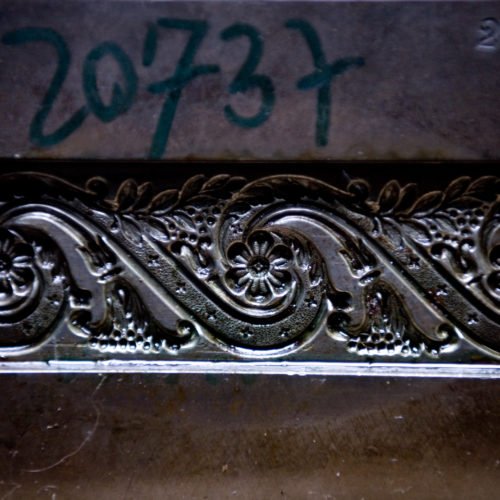
Even before becoming a necklace or a ring, each Volgara design has existed for a long time—in some cases, since 1829. It lives on in the form of a hand-engraved steel die, carefully preserved in the workshop of our French stamping supplier. Here is the story of this craftsmanship, and how it gives rise to your jewelry.
What exactly is a stamp?
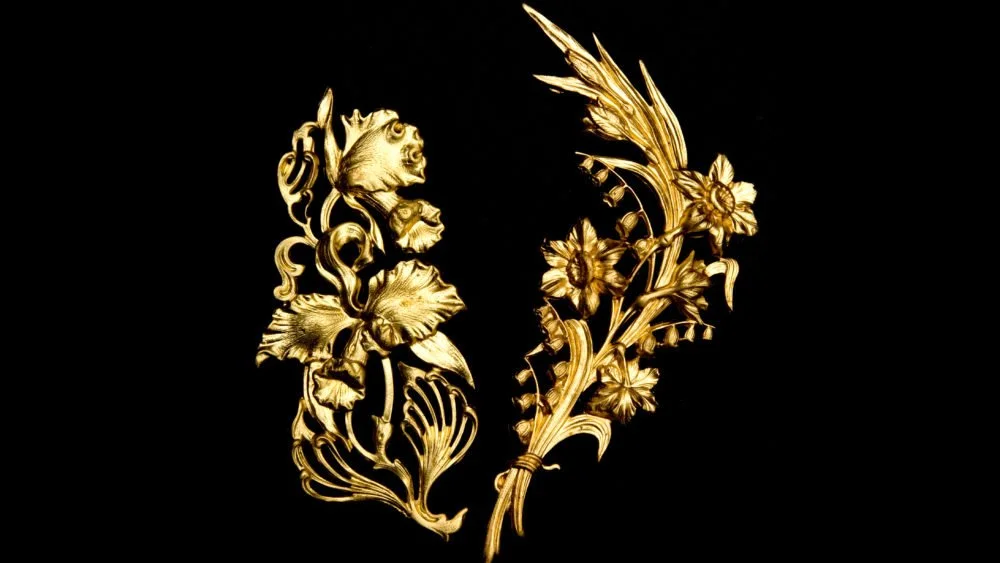
An embossed design is a bas-relief pattern created by striking a sheet of brass between a hand-engraved die and a hand-engraved punch made of hardened steel. It is this original engraving—sometimes created nearly two centuries ago—that gives the final design its exquisite level of detail—a level of precision that no industrial casting technique can reproduce exactly.
The process consists of several successive steps: the metal is first positioned on the die, then struck several times—up to four passes for the most intricate designs—to gradually bring out the relief, openwork, or embossing. Each piece is then trimmed and openworked by hand.
A family-run workshop that has been passed down through seven generations
The dies we use at Volgara come from a French company founded in 1840, which is now based in its workshop in the Paris region. The company preserves and maintains the tooling for several historic collections, the oldest die of which dates back to 1829—a heritage now recognized under the Entreprise du Patrimoine Vivant (EPV) label, awarded by the French government to recognize excellence in craftsmanship.
A rarity in the industry: this company has always been passed down through the women of the family, generation after generation, up to the current seventh generation of leaders.
Expertise that has shaped haute couture
This stamping process is not unique to costume jewelry: it has long been used for military and fashion buttons, window displays for luxury brands, and stage costumes for opera, film, and theater. The same workshops that craft our designs have thus supplied some of the biggest names in French fashion.
It is precisely this fusion of heritage and contemporary design that lies at the heart of Volgara’s identity: giving a second life to motifs engraved by artisans from a bygone era by incorporating them into jewelry designed for today.
A skill set that is becoming increasingly rare
Traditional stamping now faces competition from faster and less expensive industrial techniques, such as laser cutting or metal injection molding—processes that allow for very large-scale production but cannot reproduce either the openwork relief or the fine detail characteristic of traditional stamping. The French workshops that still carry on this artisanal craft—at the cost of meticulously maintaining tools that are sometimes a century old—can now be counted on one hand.
So when you choose Volgara jewelry, you’re not just wearing a design—you’re wearing a piece of rare French craftsmanship that is on the verge of disappearing if no one continues to keep it alive.
From the stamped blank to the finished piece of jewelry
Once shaped, each stamped piece is sent to our workshop in Nice, where it is assembled by hand: gilded with 24k fine gold or plated with 3 microns of gold, sometimes set with semi-precious stones and natural pearls, and always guaranteed to be nickel- and lead-free. It is this two-step process—the traditional craftsmanship of stamping, followed by handcrafted assembly in our workshop—that gives each Volgara piece its unique character and rich history.